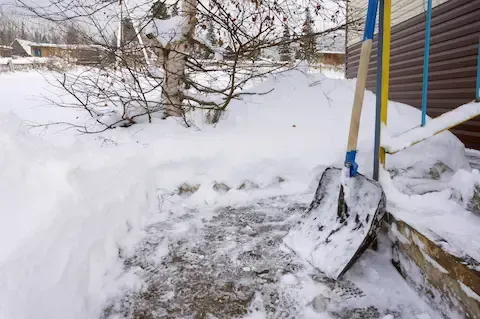
Front Step Snow Clearing for Mail Delivery in Rochelle
Most Rochelle homeowners think about snow in terms of getting their car out of the driveway. But there is a quieter problem that builds up during the heavy winter weeks that Northern Illinois is known for — a front step that does not get cleared. When a USPS carrier approaches your door and finds packed snow, ice, or an unsafe approach, they are permitted to skip delivery entirely. That means packages, medications, bills, and important correspondence sit at the post office or get returned, sometimes without any notification at all. Understanding why this happens and what you can do about it makes winter in Rochelle significantly easier to manage.
How USPS Carriers Make Access Decisions
Postal carriers follow safety guidelines that give them discretion when a delivery point appears hazardous. This is not a strict policy that requires a supervisor's approval — it is a judgment call made in the field, in real time, often during the worst weather of the year. If a front step is icy, if there is no clear path from the sidewalk to the door, or if the approach requires climbing through accumulated snow, a carrier can mark the delivery as attempted and move on.
In Rochelle, this becomes especially relevant in January and February, when back-to-back storms can leave even recently shoveled steps buried again within hours. A carrier on a tight route does not have time to wait, and they are not required to risk a fall or injury to complete a drop-off. The result is a missed delivery that often confuses homeowners who assume their step was clear enough.
What Counts as a Safe Front Step Access
Safe access in the eyes of a postal carrier means a walkable, stable path from the public sidewalk to the mailbox or door, with steps that are visibly clear of ice and snow. It does not mean perfectly dry concrete — that is not a reasonable expectation in Northern Illinois winters. What matters is whether a person in delivery shoes can approach without a realistic risk of slipping or falling.
Practically speaking, this means your steps should be shoveled to the surface, treated with salt or sand to reduce ice, and free of the heavy ice crust that often forms after a freeze-thaw cycle. Handrails should be accessible. If snow is actively falling, a cleared step from two hours ago may already be an issue again. The standard is not about perfection, but it is higher than most homeowners assume.
For households in Rochelle that receive frequent deliveries — or anyone depending on regular mail for prescriptions, legal documents, or business correspondence — maintaining that standard consistently through the winter becomes a real operational challenge. This is especially true during extended cold stretches when ice refreezes overnight after afternoon melt.
The Problem With Sporadic Clearing
Many homeowners shovel when they see a storm coming and then again after the heaviest accumulation ends. That approach works for the driveway, but front steps have a different exposure pattern. They collect wind-driven snow, drip-freeze from roof overhangs, and accumulate ice from foot traffic that packs down whatever was left loose. The result is that a step shoveled on Monday morning can be dangerously iced by Tuesday afternoon without any additional snowfall.
Sporadic clearing also creates a false sense of security. If your step looked fine when you left for work, you may not realize it has refrozen by the time your carrier makes their afternoon run. In Rochelle, where routes can stretch into the late afternoon during heavy delivery days, this timing gap is significant. Carriers completing routes during the coldest part of the day, after temperatures have dropped again from a midday high, encounter conditions that were not present when the homeowner last checked.
The solution is not necessarily shoveling more often — it is building a consistent treatment routine that accounts for refreeze, not just initial accumulation. That often means applying ice melt or coarse salt after clearing, and checking again before peak delivery windows when possible.
Entrance Clearing as a Service, Not a Task
For households that struggle to keep up with front step clearing — whether due to age, mobility, schedule, or the sheer pace of a Northern Illinois winter — outsourcing that single access point makes practical sense. You do not need a full snow removal contract to solve a front step problem. Targeted Entrance Snow Clearing focuses specifically on maintaining safe access at the door, which is the most critical point for mail delivery, package drop-off, and emergency access.
Having a professional crew make entrance clearing part of a regular route means your steps are treated consistently after each weather event, not just when you have time. In a winter like Rochelle typically sees, that difference can mean the gap between consistent delivery and a month of missed packages.
Ice Buildup at the Doorway Is a Related Issue
Front step access is not just about snow depth — it is often about ice. The area immediately at the base of a front door is especially prone to ice formation because it receives runoff from the door threshold, drip from overhangs, and foot traffic compression. Addressing that specific zone requires more than shoveling. It requires understanding where water collects, where it refreezes, and how to treat those surfaces without damaging the concrete or creating a salt tracking problem inside the home.
If your doorway area is consistently icy even after clearing, it is worth reviewing how you are approaching the problem. The post on stopping doorway ice buildup covers the specific dynamics that cause repeated icing at entryways and what sustainable solutions look like for Rochelle properties.
What Happens When Delivery Is Interrupted
When a carrier skips a delivery, most homeowners do not find out until they notice the item did not arrive. USPS does not always leave a notice for a safety-related skip the way they do for a signature-required package. The item may sit at the Rochelle Post Office on 4th Avenue for a short window before being returned to sender or reattempted on a different day. For time-sensitive mail, that delay can carry real consequences.
Repeated skips on the same address can also flag the house for reduced service or restricted delivery, which requires contacting the local post office to resolve. Preventing that situation is far easier than correcting it after the fact. A single cleared front step, maintained consistently, removes the issue from the table entirely.
Practical Winter Access in Rochelle
Rochelle sits in a part of Northern Illinois that sees sustained cold, lake-effect-adjacent snowfall patterns, and significant wind that redistributes cleared snow back onto steps and walkways. That combination means front step clearing is not a one-time task at the start of a storm — it is an ongoing winter responsibility that requires attention through the entire season, often through March. Planning for that reality, rather than treating each storm as a standalone event, is what keeps access reliable when carriers come through on their daily routes.
